How Sports Logos on Masks and Better Signage Can Help Prevent COVID-19, According to Social Science
Feature Story
By Megan Lowry
Last update October 1, 2020
By now, we’ve all heard the official COVID-19 prevention guidance: Wear a mask, wash your hands, and stay 6 feet away from other people. But hearing information, and turning it into an everyday habit, are two very different things.
For decades, social and behavioral scientists have studied how to change our habits — whether that change is eating healthier or wearing a seatbelt. This research has produced a wealth of knowledge about which messages and strategies are most likely to create lasting changes in our daily routines.
“The challenge that we’re dealing with at this point with this virus is largely a behavioral science challenge. How can we get people to change their behavior so that we’re not all exposed?” said Wendy Wood, provost professor of psychology and business, University of Southern California, and one of the authors of a new guide to behavior change and COVID-19 prevention from the National Academies of Sciences, Engineering, and Medicine’s Societal Experts Action Network (SEAN).
During a recent webinar, the guide’s authors discussed five strategies for encouraging behavior change at the local or community level, and how they can be applied to COVID-19 prevention.
1. Make behaviors easy to start and repeat.
It’s a simple concept, but research shows that “removing friction,” or in other words, taking away the factors that make a behavior hard to adopt, makes it easier to start and repeat a new behavior. Wood explained that “some of the evidence suggesting that removing friction is really effective comes from studies of people in hospitals … Hospital visitors were five times more likely to use a sanitizer when it was in the lobby and easy to access.”
“Providing space guidelines, such as circles or cues that make it easier to figure out what the appropriate distance is,” Wood said, is one example of how public health leaders can make it easy for people to get in the habit of staying 6 feet apart when outside or in public.
2. Make changing a behavior rewarding and fun.
“Only when behaviors are rewarding to us are we likely to repeat them often enough for a habit to form,” said Wood. There’s evidence that when you pay people to work out in the gym, for example, they’re more likely to come back.
Something that makes it more rewarding or fun to wear a mask, like decorating it with the logo of your favorite sports team or coordinating it with your favorite outfit, can make it more likely that you’ll continue to wear it. “It is how you interpret that behavior that can make it rewarding,” said Wood.
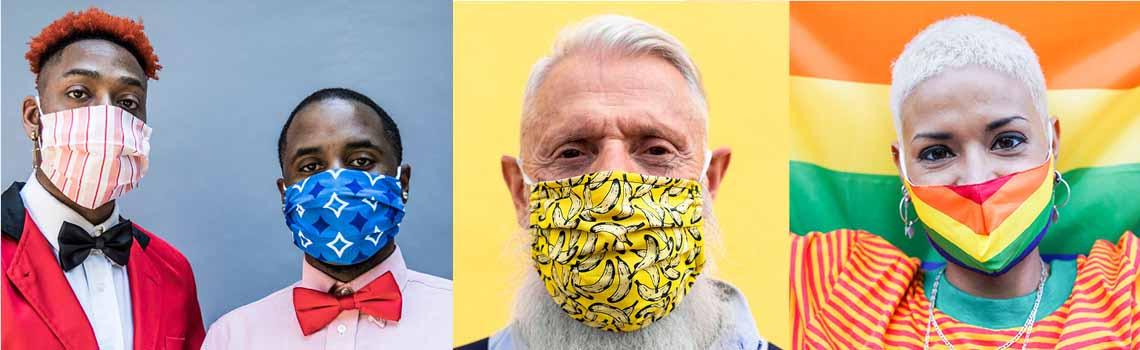
3. Tie a new behavior to existing habits.
“You can think of this as ‘stacking’ ... stacking a new behavior onto an existing habit, so that you take advantage of automaticity,” said Wood. “Many people do this naturally, like with taking pills. You might put them next to your toothbrush,” she offered as a way to remember to take them at night or in the morning. Advising people to keep their masks by the front door, for example, makes it automatic to associate leaving the house with grabbing a mask.
4. Communicate which habits are outdated or should stop.
Location and habit are linked, and public health leaders can take advantage of these links to discourage certain behaviors. “So you could have a sign about not shaking hands in the workplace where people could be most likely to do it,” said Wood.
When others do not follow recommended behaviors for preventing the spread of COVID-19, “It’s important to have people that point it out,” said Dominique Brossard, professor and chair in the department of life sciences communication, University of Wisconsin, who also helped develop the SEAN guidance. But Brossard cautioned that calling out unwanted behaviors, such not wearing a mask, should come from that person’s social group. Otherwise, criticism can backfire and lead to a defensive or resistant response.
Where possible, communicators should avoid giving too much attention to the behaviors we don’t want to see. “By pointing too much to the frequency of socially undesirable behaviors,” such as crowding in bars or not wearing masks, “we may promote the idea that they are more frequent than they actually are,” added Brossard.
5. Provide clear, specific descriptions of the behavior you want to see.
A clear and specific description can help people understand exactly what they are supposed to do. “Saying, ‘if you’re inside, then masks are required when you have extended contact,’ … you can’t implement that in a very clear way,” said Wood. “A sign that says ‘masks required’ is much easier to understand and actually follow through with.”
Using the phrase “physical distancing” in place of social distancing, for example, is a more specific way to communicate the need to stay 6 feet apart. “You can be socially close and physically distant, and that’s what we want,” said Brossard. Wood also explained that providing examples of what 6-feet-apart looks like in practice can also help people visualize the distance they’re supposed to maintain, such as “the length of two dogs.”
Signs with specific, clear descriptions and examples of the behaviors people are expected to follow are most effective.
Consistent messaging is key to the success of any of these strategies. And local officials in particular have an opportunity to bring communicators together and build messages that work for their community’s specific values and needs.
“One of the most powerful tools that local officials possess is the ability to convene others,” said Ron Carlee, assistant professor of public service at Old Dominion University; former city manager, Charlotte, North Carolina; and former county manager, Arlington, Virginia. “Convene professional communicators in your region. Include marketing firms and corporate communication directors. Ask them to review the recommendations in the SEAN report and develop local messaging.”
Related Links:
Featured Publication
Encouraging Adoption of Protective Behaviors to Mitigate the Spread of COVID-19: Strategies for Behavior Change
Rapid Expert Consultation
·2020
This rapid expert consultation is intended to help decision makers identify strategies for increasing adherence to protective behaviors that can mitigate the spread of COVID-19. Ultimately, the focus is on increasing knowledge, reducing barriers, and emphasizing efforts that make healthier choices e...
View details
More like this


Discover
Events
Right Now & Next Up
Stay in the loop with can’t-miss sessions, live events, and activities happening over the next two days.
NAS Building Guided Tours Available!
Participate in a one-hour guided tour of the historic National Academy of Sciences building, highlighting its distinctive architecture, renowned artwork, and the intersection of art, science, and culture.